Wi-Fi 8: an invisible revolution...
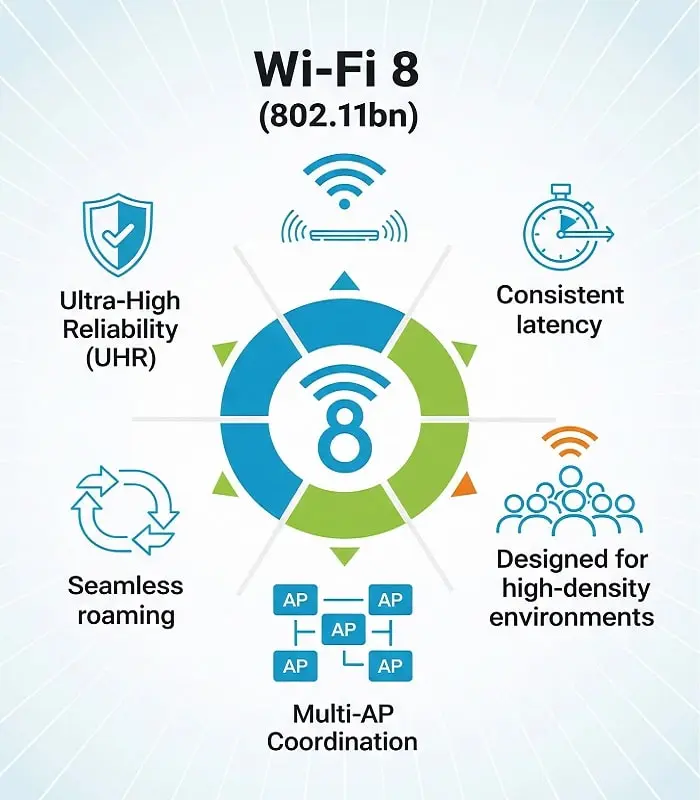


As Wi-Fi 7 is just beginning to be deployed in professional environments, the industry is already preparing for the next step: Wi-Fi 8 (IEEE 802.11bn).
At first glance, this new generation may seem confusing: no record speeds, no spectacular figures to display on a product sheet. And yet, Wi-Fi 8 may well be the most important generation since Wi-Fi 6.
Why? Because it no longer seeks to break theoretical records, but to solve real Wi-Fi problems on the ground.
Wi-Fi 8: Forget the race for speed
For several generations, the evolution of Wi-Fi has often been summarized by a single metric: maximum throughput.
Wi-Fi 6, Wi-Fi 6E, Wi-Fi 7… each standard promised ever-higher speeds.
👉 Wi-Fi 8 deliberately breaks with this logic.
According to MediaTek, one of the main players in the standard, the maximum PHY throughput of Wi-Fi 8 will be similar to that of Wi-Fi 7.
In other words:
no new marketing figures at 60 or 80 Gb/s,
no visible revolution on a standard speed test.
And this is fully acknowledged.
Where Wi-Fi 8 really changes the game: the real world
Wi-Fi 8 has been designed to answer a simple question:
Why does a very fast Wi-Fi network on paper become unstable, slow, or unpredictable in real life?
1️⃣ Significantly improved performance in degraded conditions
Initial work on Wi-Fi 8 shows:
up to 2× more real throughput in complex environments,
up to 7× less latency in certain situations.
This directly concerns:
extended sites,
buildings with thick walls,
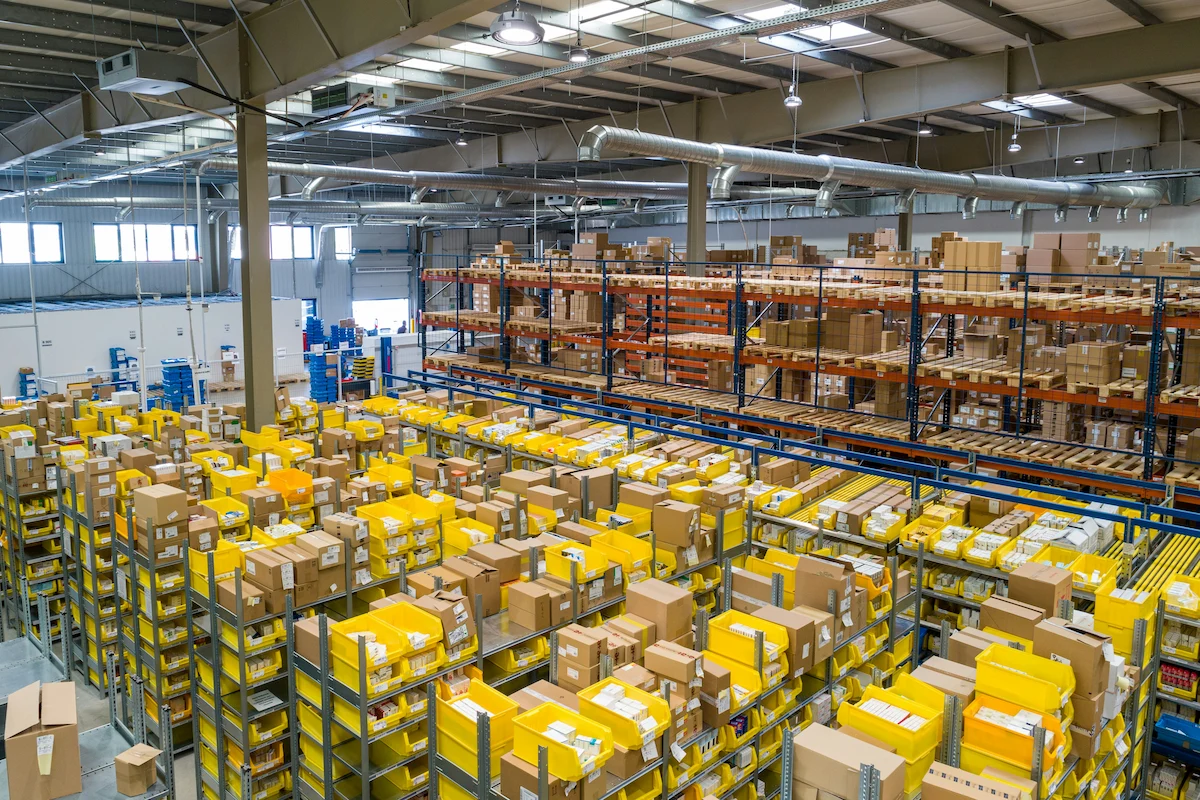
industrial or logistical environments,
sites heavily affected by interference.
2️⃣ Coverage and stability much higher
Wi-Fi 8 introduces several key mechanisms:
Enhanced Long Range (ELR)
→ significant improvement in long-distance performance, particularly on uploads.
Distributed Resource Units (DRU)
→ better spectrum utilization when the signal is weak or unstable.
Result:
📶 fewer dead zones,
📶 fewer clients “hanging on” to an AP too far away,
📶 better overall network stability.
3️⃣ Wi-Fi finally becomes “cellular” in its behavior
One of the major focuses of Wi-Fi 8 is advanced multi-access point coordination.
We are approaching a functionality comparable to mobile networks:
intelligent coordination between APs,
smooth roaming of the “make-before-break” type,
decisions made at the network level and no longer solely by the client.
👉 For dense multi-AP environments (train stations, campuses, hospitals, stadiums, industrial sites), this is a major structural change.
4️⃣ Better energy efficiency
Another often overlooked point: energy consumption.
Wi-Fi 8 aims for:
a reduction in consumption on the client side,
smarter management of activity and sleep periods,
a direct impact on the autonomy of devices (IoT, tablets, industrial equipment).
In a world where Wi-Fi is omnipresent, this point becomes strategic.
How will we know we are using Wi-Fi 8?
This is one of the key messages:
👉 Wi-Fi 8 is not easily “seen”.
No spectacular throughput peak.
No obvious difference on a simple speed test.
To observe the gains of Wi-Fi 8, one will need to:
analyze latency,
measure stability over time,
test roaming,
observe performance at the edge of the cell,
instrument networks with advanced tools.
In other words: Wi-Fi 8 is primarily aimed at network engineers, not marketing sheets.
Timeline: When will Wi-Fi 8 arrive?
📅 The major known milestones:
Wi-Fi Alliance certification expected in 2028,
first Wi-Fi 8 client devices expected in early 2028,
technological demonstrations planned as early as 2026 at major trade shows.
👉 In the short term, Wi-Fi 7 remains the benchmark standard for modern deployments.
👉 In the medium term, Wi-Fi 8 will establish itself in critical and complex environments.
Conclusion: Wi-Fi 8, an engineer's standard
Wi-Fi 8 does not seek to impress.
It aims to reliably, stabilize, and industrialize Wi-Fi.
It is a standard:
less visible,
less “salesy”,
but fundamental for the future of professional networks.
👉 For businesses, communities, and large sites, Wi-Fi 8 could mark the transition between high-performance Wi-Fi... and Wi-Fi that is truly predictable and controlled.

As Wi-Fi 7 is just beginning to be deployed in professional environments, the industry is already preparing for the next step: Wi-Fi 8 (IEEE 802.11bn).
At first glance, this new generation may seem confusing: no record speeds, no spectacular figures to display on a product sheet. And yet, Wi-Fi 8 may well be the most important generation since Wi-Fi 6.
Why? Because it no longer seeks to break theoretical records, but to solve real Wi-Fi problems on the ground.
Wi-Fi 8: Forget the race for speed
For several generations, the evolution of Wi-Fi has often been summarized by a single metric: maximum throughput.
Wi-Fi 6, Wi-Fi 6E, Wi-Fi 7… each standard promised ever-higher speeds.
👉 Wi-Fi 8 deliberately breaks with this logic.
According to MediaTek, one of the main players in the standard, the maximum PHY throughput of Wi-Fi 8 will be similar to that of Wi-Fi 7.
In other words:
no new marketing figures at 60 or 80 Gb/s,
no visible revolution on a standard speed test.
And this is fully acknowledged.
Where Wi-Fi 8 really changes the game: the real world
Wi-Fi 8 has been designed to answer a simple question:
Why does a very fast Wi-Fi network on paper become unstable, slow, or unpredictable in real life?
1️⃣ Significantly improved performance in degraded conditions
Initial work on Wi-Fi 8 shows:
up to 2× more real throughput in complex environments,
up to 7× less latency in certain situations.
This directly concerns:
extended sites,
buildings with thick walls,
industrial or logistical environments,
sites heavily affected by interference.
2️⃣ Coverage and stability much higher
Wi-Fi 8 introduces several key mechanisms:
Enhanced Long Range (ELR)
→ significant improvement in long-distance performance, particularly on uploads.
Distributed Resource Units (DRU)
→ better spectrum utilization when the signal is weak or unstable.
Result:
📶 fewer dead zones,
📶 fewer clients “hanging on” to an AP too far away,
📶 better overall network stability.
3️⃣ Wi-Fi finally becomes “cellular” in its behavior
One of the major focuses of Wi-Fi 8 is advanced multi-access point coordination.
We are approaching a functionality comparable to mobile networks:
intelligent coordination between APs,
smooth roaming of the “make-before-break” type,
decisions made at the network level and no longer solely by the client.
👉 For dense multi-AP environments (train stations, campuses, hospitals, stadiums, industrial sites), this is a major structural change.
4️⃣ Better energy efficiency
Another often overlooked point: energy consumption.
Wi-Fi 8 aims for:
a reduction in consumption on the client side,
smarter management of activity and sleep periods,
a direct impact on the autonomy of devices (IoT, tablets, industrial equipment).
In a world where Wi-Fi is omnipresent, this point becomes strategic.
How will we know we are using Wi-Fi 8?
This is one of the key messages:
👉 Wi-Fi 8 is not easily “seen”.
No spectacular throughput peak.
No obvious difference on a simple speed test.
To observe the gains of Wi-Fi 8, one will need to:
analyze latency,
measure stability over time,
test roaming,
observe performance at the edge of the cell,
instrument networks with advanced tools.
In other words: Wi-Fi 8 is primarily aimed at network engineers, not marketing sheets.
Timeline: When will Wi-Fi 8 arrive?
📅 The major known milestones:
Wi-Fi Alliance certification expected in 2028,
first Wi-Fi 8 client devices expected in early 2028,
technological demonstrations planned as early as 2026 at major trade shows.
👉 In the short term, Wi-Fi 7 remains the benchmark standard for modern deployments.
👉 In the medium term, Wi-Fi 8 will establish itself in critical and complex environments.
Conclusion: Wi-Fi 8, an engineer's standard
Wi-Fi 8 does not seek to impress.
It aims to reliably, stabilize, and industrialize Wi-Fi.
It is a standard:
less visible,
less “salesy”,
but fundamental for the future of professional networks.
👉 For businesses, communities, and large sites, Wi-Fi 8 could mark the transition between high-performance Wi-Fi... and Wi-Fi that is truly predictable and controlled.
Category
Infrastructure & Networks
Latest news and trends
Looking to join a company where Wi-Fi expertise makes a difference?
At Meltwain, we value talents who are passionate about networking, service quality, and innovation. Join a certified team (CWNE, ECSE, Ubiquiti...) and contribute to exciting technical projects in Luxembourg and Europe.

Looking to join a company where Wi-Fi expertise makes a difference?
At Meltwain, we value talents who are passionate about networking, service quality, and innovation. Join a certified team (CWNE, ECSE, Ubiquiti...) and contribute to exciting technical projects in Luxembourg and Europe.

Looking to join a company where Wi-Fi expertise makes a difference?
At Meltwain, we value talents who are passionate about networking, service quality, and innovation. Join a certified team (CWNE, ECSE, Ubiquiti...) and contribute to exciting technical projects in Luxembourg and Europe.