WiFi Study: No More Guesswork!

Professional Wi-Fi Study: Avoid dead zones and overcosts with a precise network audit

The most costly mistake in a WiFi project is also the most common: buying a box of access points, installing them where there are available RJ45 outlets, and crossing your fingers that "it works out." In jargon, we call this "Plug & Pray" (Plug and Pray).

The problem? Radio waves are invisible, but they obey strict physical laws. Ignoring them inevitably leads to user complaints, slowdowns, and disconnections.

This is why deploying a network without prior study is a bet you are sure to lose, and why engineering before work is your best investment.

1. The myth of "The more access points, the better"

This is the false belief number 1. If the WiFi reception is poor, the reflex is often to add an additional access point.

The reality: Too many access points kill the WiFi. If you install access points too close to each other without adjusting their power, they will "shout" at the same time on the same frequencies. This is called Co-Channel Interference (CCI). For your computer, it's like trying to listen to a conversation in a room where everyone is screaming. Result: you have 4 bars of signal, but the internet is unusable.

A WiFi study calculates the exact location so that the access points complement each other without interfering.

2. Walls are not transparent (attenuation)

You cannot guess how the waves will propagate just by looking at a plan.

  • A drywall partition lets the signal through.

  • A reinforced concrete elevator shaft completely blocks it.

  • A metal shelving unit in a warehouse bounces the signal everywhere (multipath).

  • A modern "anti-UV" tinted glass can block WiFi as effectively as a brick wall.

The WiFi study (especially the predictive study) simulates these materials to predict exactly where the signal will stop.
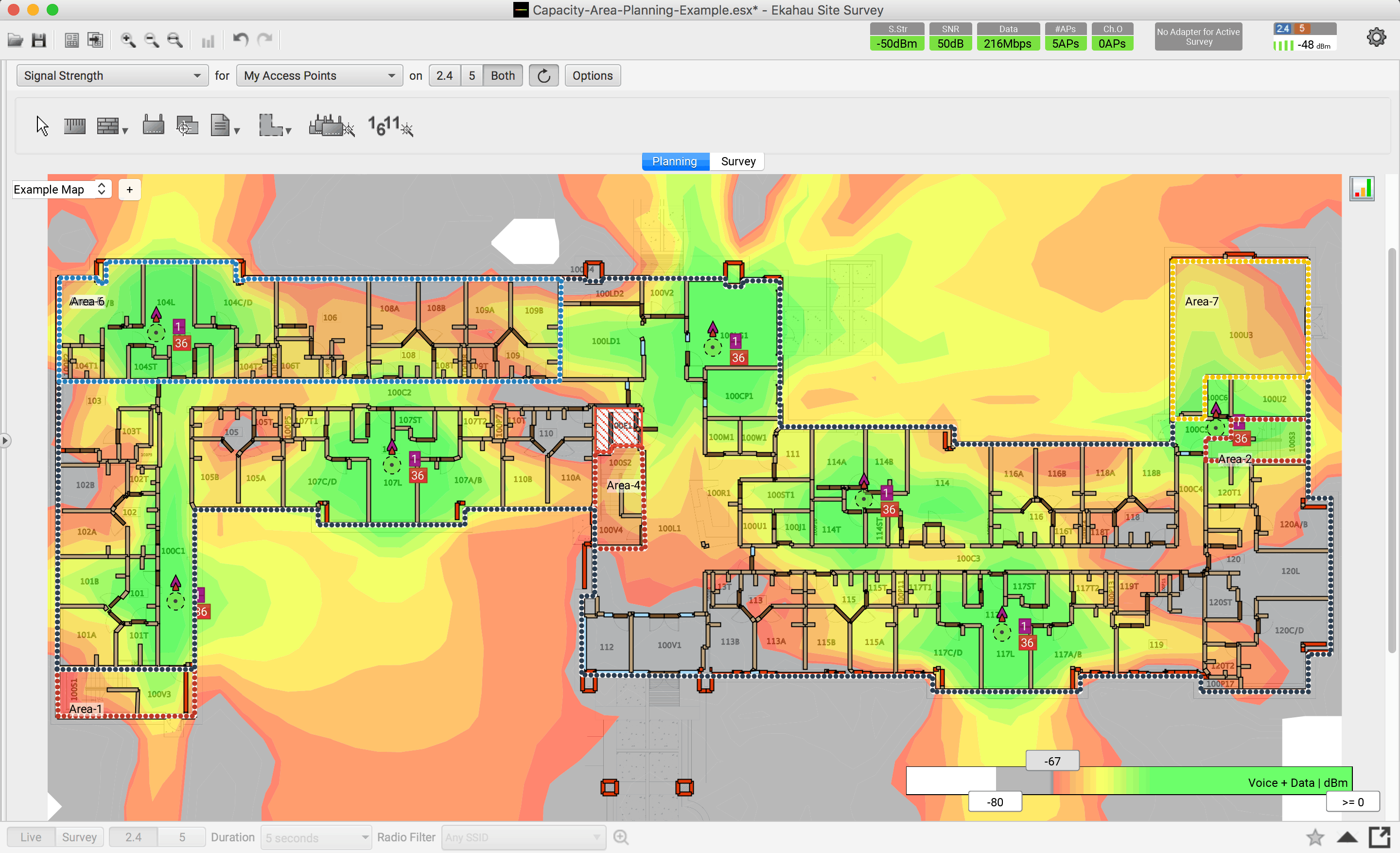

Carte thermique d'une étude de site Wi-Fi prédictive garantissant une couverture optimale

3. Ensuring Roaming (Seamless roaming)

In offices or a warehouse, users move around. They need to switch from access point A to access point B without their Teams call dropping or their scanner losing connection.

If the access points are placed randomly, it often creates "Sticky Client" zones: your device desperately clings to a distant access point (that it poorly receives) while it is under another access point (that it ignores). A well-done study sets the transition thresholds to ensure a smooth handover.

4. Capacity vs Coverage: The density trap

Covering an area is easy. Supporting 50 users in that area is another story. Placing an access point on the ceiling of a meeting room may be enough for coverage. But if 20 people start a video call at the same time, that single access point will collapse.

The WiFi study does not just look at square meters; it looks at usage. It allows you to say: "Here, we need two directional access points to support the load, not a classic omnidirectional one."

5. The economic argument: Get it right the first time

It's mathematical:

  • Without a study: You buy 10 access points "on a whim." It doesn’t work. You have to pay a technician to move the wiring (costly), buy 2 additional access points, or worse, you realize you bought 4 too many that disrupt the network.

  • With a study: You know you need exactly 8 access points, placed at specific locations. The wiring is pulled to the right place from the start.

The cost of the study is always less than the cost of redoing a poorly designed network.

Conclusion

WiFi is not magic; it’s engineering. A WiFi study (predictive or on-site like "AP-on-a-Stick") is the architectural plan of your network. Would you build a house without plans? Don’t build your digital network without a study.
The most costly mistake in a WiFi project is also the most common: buying a box of access points, installing them where there are available RJ45 outlets, and crossing your fingers that "it works out." In jargon, we call this "Plug & Pray" (Plug and Pray).

The problem? Radio waves are invisible, but they obey strict physical laws. Ignoring them inevitably leads to user complaints, slowdowns, and disconnections.

This is why deploying a network without prior study is a bet you are sure to lose, and why engineering before work is your best investment.

1. The myth of "The more access points, the better"

This is the false belief number 1. If the WiFi reception is poor, the reflex is often to add an additional access point.

The reality: Too many access points kill the WiFi. If you install access points too close to each other without adjusting their power, they will "shout" at the same time on the same frequencies. This is called Co-Channel Interference (CCI). For your computer, it's like trying to listen to a conversation in a room where everyone is screaming. Result: you have 4 bars of signal, but the internet is unusable.

A WiFi study calculates the exact location so that the access points complement each other without interfering.

2. Walls are not transparent (attenuation)

You cannot guess how the waves will propagate just by looking at a plan.

  • A drywall partition lets the signal through.

  • A reinforced concrete elevator shaft completely blocks it.

  • A metal shelving unit in a warehouse bounces the signal everywhere (multipath).

  • A modern "anti-UV" tinted glass can block WiFi as effectively as a brick wall.

The WiFi study (especially the predictive study) simulates these materials to predict exactly where the signal will stop.


Carte thermique d'une étude de site Wi-Fi prédictive garantissant une couverture optimale

3. Ensuring Roaming (Seamless roaming)

In offices or a warehouse, users move around. They need to switch from access point A to access point B without their Teams call dropping or their scanner losing connection.

If the access points are placed randomly, it often creates "Sticky Client" zones: your device desperately clings to a distant access point (that it poorly receives) while it is under another access point (that it ignores). A well-done study sets the transition thresholds to ensure a smooth handover.

4. Capacity vs Coverage: The density trap

Covering an area is easy. Supporting 50 users in that area is another story. Placing an access point on the ceiling of a meeting room may be enough for coverage. But if 20 people start a video call at the same time, that single access point will collapse.

The WiFi study does not just look at square meters; it looks at usage. It allows you to say: "Here, we need two directional access points to support the load, not a classic omnidirectional one."

5. The economic argument: Get it right the first time

It's mathematical:

  • Without a study: You buy 10 access points "on a whim." It doesn’t work. You have to pay a technician to move the wiring (costly), buy 2 additional access points, or worse, you realize you bought 4 too many that disrupt the network.

  • With a study: You know you need exactly 8 access points, placed at specific locations. The wiring is pulled to the right place from the start.

The cost of the study is always less than the cost of redoing a poorly designed network.

Conclusion

WiFi is not magic; it’s engineering. A WiFi study (predictive or on-site like "AP-on-a-Stick") is the architectural plan of your network. Would you build a house without plans? Don’t build your digital network without a study.

Category

Infrastructure & Networks

Infrastructure & Networks

Infrastructure & Networks

Blog & Articles
Blog & Articles
Blog & Articles

Latest news and trends

Career

Looking to join a company where Wi-Fi expertise makes a difference?

At Meltwain, we value talents who are passionate about networking, service quality, and innovation. Join a certified team (CWNE, ECSE, Ubiquiti...) and contribute to exciting technical projects in Luxembourg and Europe.

Deux professionnels collaborent lors d'une séance de brainstorming
Career

Looking to join a company where Wi-Fi expertise makes a difference?

At Meltwain, we value talents who are passionate about networking, service quality, and innovation. Join a certified team (CWNE, ECSE, Ubiquiti...) and contribute to exciting technical projects in Luxembourg and Europe.

Deux professionnels collaborent lors d'une séance de brainstorming
Career

Looking to join a company where Wi-Fi expertise makes a difference?

At Meltwain, we value talents who are passionate about networking, service quality, and innovation. Join a certified team (CWNE, ECSE, Ubiquiti...) and contribute to exciting technical projects in Luxembourg and Europe.

Deux professionnels collaborent lors d'une séance de brainstorming

Based in Luxembourg, Meltwain supports businesses and institutions in establishing Wi-Fi networks that are reliable, high-performing, and perfectly tailored to their environment, with a startup flair.

© 2025 Meltwain Inc. All rights reserved

Based in Luxembourg, Meltwain supports businesses and institutions in establishing Wi-Fi networks that are reliable, high-performing, and perfectly tailored to their environment, with a startup flair.

© 2025 Meltwain Inc. All rights reserved

Based in Luxembourg, Meltwain supports businesses and institutions in establishing Wi-Fi networks that are reliable, high-performing, and perfectly tailored to their environment, with a startup flair.

© 2025 Meltwain Inc. All rights reserved