

Wi-Fi survey and audit in Luxembourg
We measure your wireless network, from floor plans before the works or with a site survey once the access points are up. You receive the coverage heatmaps, the gap analysis and the list of corrections.
Every survey is led by an engineer certified CWNE #536, a title held by fewer than 600 experts worldwide.
When a Wi-Fi survey is needed
A survey is useful before, during and after a deployment. The type of measurement depends on when you call us.

Before an installation
New building, office move or extension. The predictive survey sets the number of access points and their positions before cabling.
On a network that drops out
Frozen video calls, dead zones, uneven speeds. On-site measurements find the cause.
After a deployment
The validation survey checks that the installed network meets the targets set at the start.

Scoping and success criteria
Before any measurement, we agree with you what the network must deliver. These criteria stay the reference until the report.
Uses
Voice over IP, video calls, connected devices and critical applications, with the quality of service each one needs.
Thresholds
Signal strength (RSSI), signal-to-noise ratio (SNR), minimum throughput, areas to cover.
Existing network
Access point models, controller, cabling, number of devices per area.
Predictive survey before deployment
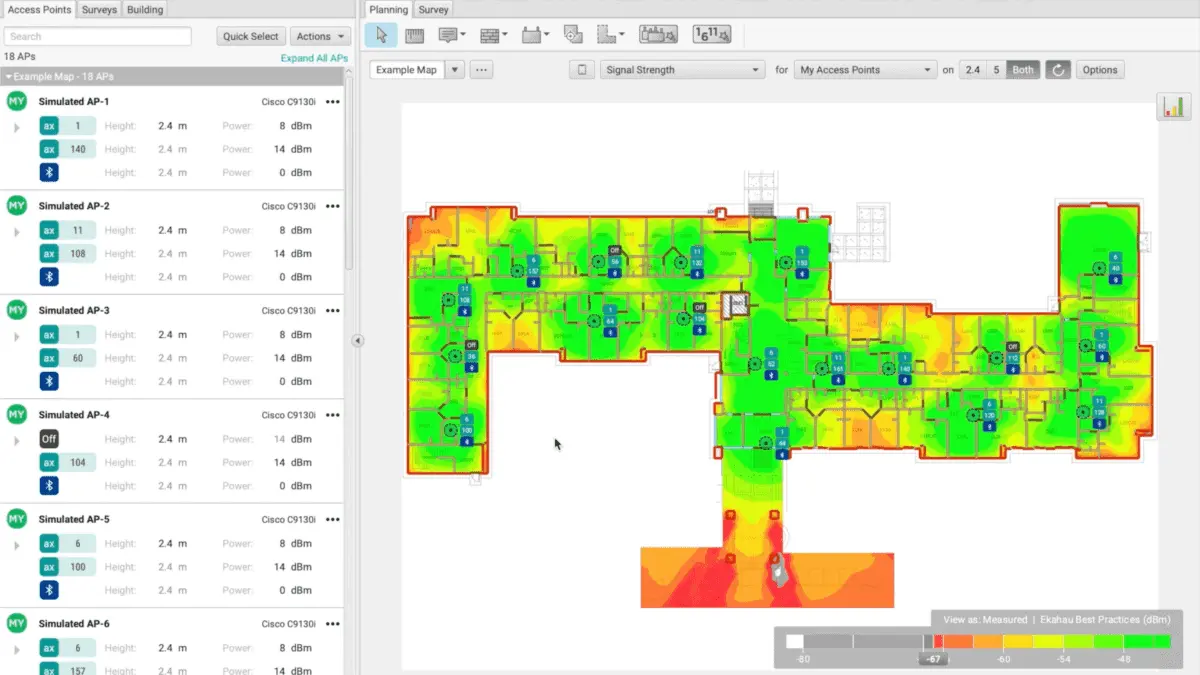
We import your floor plans into Ekahau, give each wall, window and rack its attenuation, and place access points in the model until the scoping thresholds are met. You get an access point layout: the position, height, channel and power of each one.

On-site survey with real measurements
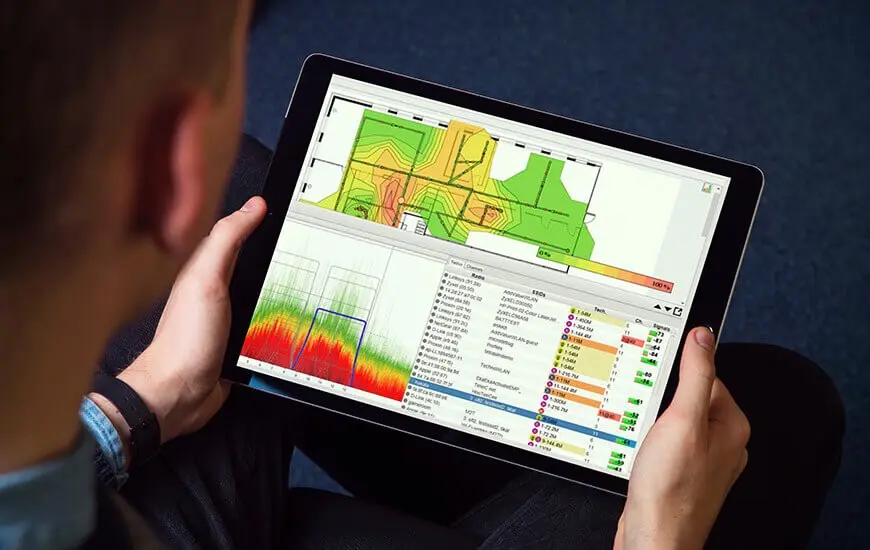
On a live network, the engineer walks every area with the survey kit.
Survey walk
Several thousand data points recorded: signal strength, signal-to-noise ratio, interference.
Spectrum analysis
Finding noise sources that are not Wi-Fi, such as a microwave oven or a wireless camera.
Throughput tests
The speed a user gets, where they work.
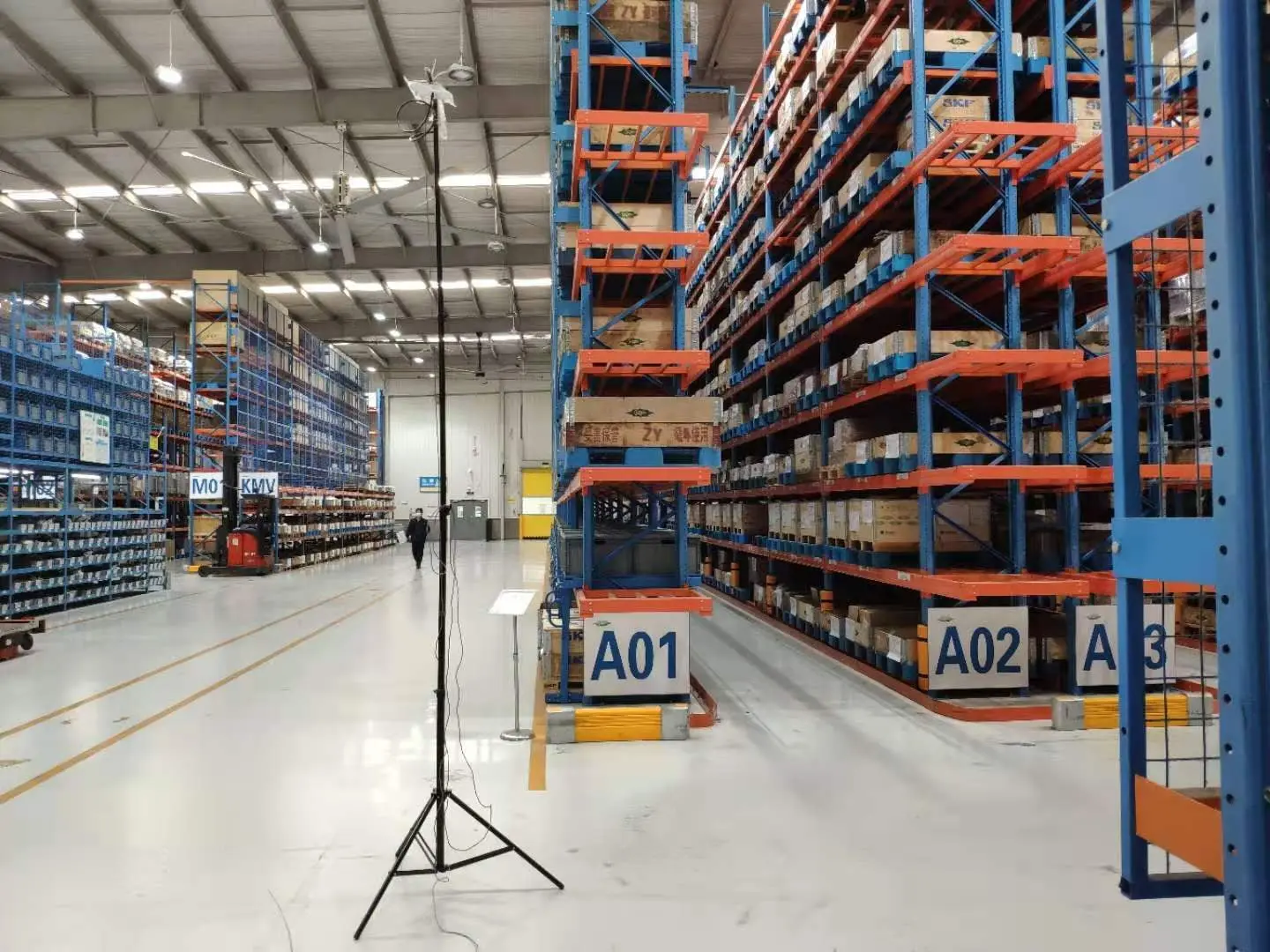
AP on a stick
A test access point on a tripod validates a position before the cable is run.
Gap analysis and corrections
We compare the heatmaps with the scoping criteria. Under-covered areas show up, and so do over-covered ones, where access points interfere with each other on the same channel. Each gap is given its cause (transmit power, the position of an access point, the channel plan, a source of interference) and its correction.
The survey report you receive
The report reads at two levels: management finds the conclusions, the technical team finds what to act on.
Summary
Main conclusions and recommendations.
Method
Tools used and steps followed.
Heatmaps
Maps of signal strength, signal-to-noise ratio and interference.
Gaps
Measured or simulated results, compared with the targets.
Action plan
Ranked corrections, for example "add 3 access points in the west wing", with the revised layout.
Appendices
Recorded configurations and spectrum analysis logs.


A client on our surveys
« For the past 2 years, Meltwain has been supporting us with our WiFi surveys. Their expertise has allowed us to better understand the WiFi challenges while benefiting from a high-quality service. I highly recommend their support. »

A survey suited to each type of site
Thresholds and survey method change with the place. Each sector has its own page.

Warehouses
Metal racking, high ceilings, devices on the move.
Hotels
Room-by-room validation, public areas, conference rooms.

Offices and coworking
Meeting rooms, open-plan floors, peak hours.
Shopping centres
Busy malls, the retailers' network.
Campsites
Outdoor measurements, under the tree canopy and between mobile homes.
Questions about Wi-Fi surveys

What is the difference between a predictive survey and an on-site survey?
A predictive survey simulates how radio waves travel, working from the building's floor plans: materials, access point positions, expected coverage. It is done before installation. An on-site survey, also known as a wireless site survey, measures the network as it runs, with professional instruments, once the access points are live. The two complement each other: the first avoids fitting access points in the wrong place, the second proves that the result meets the targets.
What signal strength should you aim for?
It depends on the use. For voice and video calls, manufacturers generally recommend a signal of at least −67 dBm and a signal-to-noise ratio of at least 25 dB, everywhere people work. A barcode scanner tolerates a weaker signal. That is why the thresholds are set at scoping, before the first measurement, and never read off the heatmap afterwards.
How much does a Wi-Fi survey cost?
The price depends on the floor area, the number of storeys and buildings, the type of survey (predictive, on-site or both) and the level of detail expected in the report. We do not publish a fixed rate, because an office floor and a high-bay warehouse do not take the same measuring time. The quote is free and follows a 30-minute call.
Do we have to stop work during the measurements?
No. The engineer walks through the premises with the survey kit and does not take the network down. Measuring in real conditions is in fact better, with desks occupied, stock in place or customers present, because people and goods change how radio waves travel. Only AP-on-a-stick tests need access to the areas concerned.
Does a survey mean replacing our equipment?
No. Our recommendations are independent of any manufacturer. Many corrections are a matter of configuration: channel plan, transmit power, moving an access point, a firmware update. The report states what can be kept, what must be moved and, only if the measurements justify it, what needs to be added or replaced.
Who carries out the survey?
An engineer certified CWNE #536, the highest certification in the trade, held by fewer than 600 experts worldwide. Meltwain also holds the Ekahau ECSE Advanced certification, issued by the maker of the measurement tools we use. You deal with a certified engineer from scoping to the handover of the report.