RF shielding and WiFi privacy
Mastering RF Propagation in Luxembourg Offices: Confidentiality, Interference, and Wi-Fi Performance
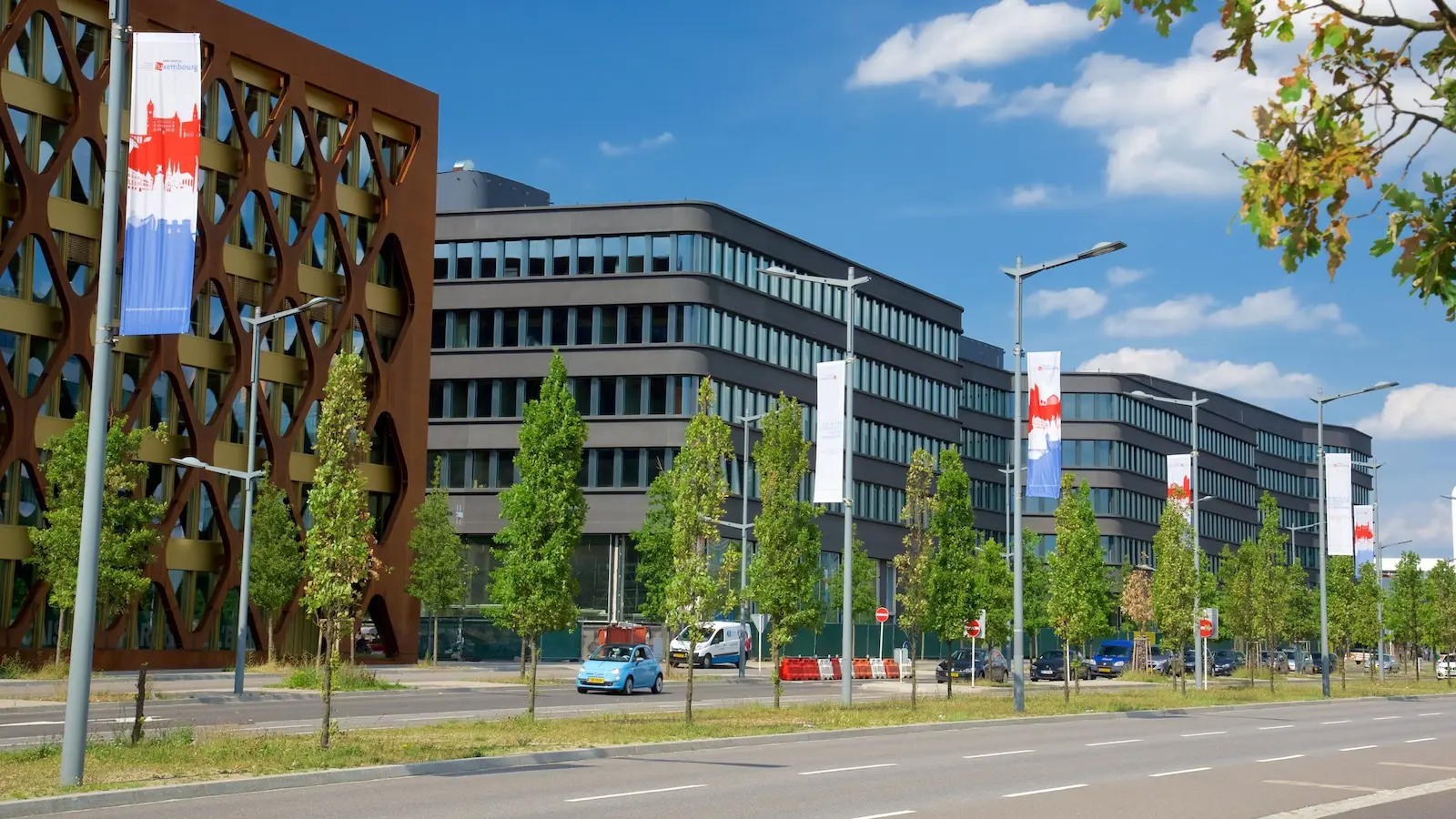
In Kirchberg, Cloche d'Or, or Belval, modern office buildings host activities with very high technical requirements: private banks, investment funds, family offices, business law firms, Big Four firms, European institutions, as well as laboratories, R&D centers, and sensitive industrial environments. For these organizations, controlling the propagation of Wi-Fi and radio signals within their premises has become a true engineering challenge—well beyond the simple issue of coverage.
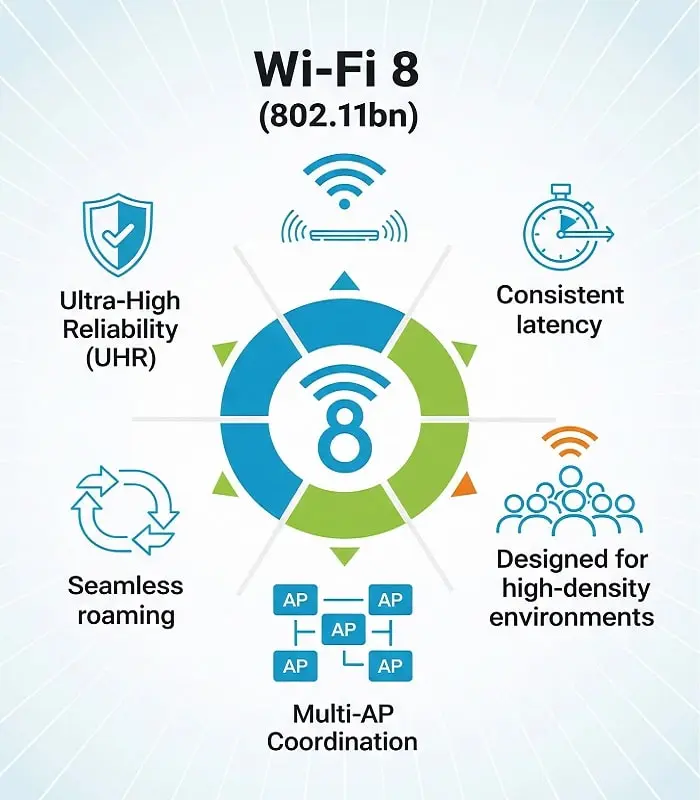
Too often, Wi-Fi is treated as a utility service deployed with the hope that it will “work everywhere.” In the reality of a modern Luxembourg building—dense, glass-heavy, and surrounded by neighboring buildings that are themselves saturated with wireless networks—this approach quickly reaches its limits. Signals do not stop where you would like them to, and they show up where you did not expect them.
This article explains how to physically control radio wave propagation in a building, what this control is concretely used for, and why it is a true engineering discipline rather than a simple finishing-work project.
Four RF Issues Affecting Luxembourg Offices
When discussing RF propagation control, confidentiality immediately comes to mind. That is legitimate, but it is only one of the four major use cases.
Interference from Neighboring Networks
In Luxembourg business districts, Wi-Fi density is extreme. In Kirchberg or Cloche d'Or, a simple scan easily reveals several dozen competing networks on the 2.4 GHz and 5 GHz bands, sometimes more than one hundred visible BSSIDs from the same open space. This radio pollution mechanically degrades performance: collisions, retransmissions, collapsed throughput, unpredictable latency.
Reducing your premises’ exposure to external signals means recovering usable bandwidth and finally providing your teams with stable Wi-Fi, especially on the 2.4 GHz band, which remains structurally saturated.
Signal Leakage Outside the Building
Conversely, your own Wi-Fi signals pass through walls and windows and remain detectable from the sidewalk, parking lot, neighboring building, or café across the street. For most companies, this is just a detail. For those handling sensitive data, it is a security vulnerability: a remotely accessible attack surface, exposure to evil twin, deauthentication, and rogue AP attacks, as well as war driving attempts.
In Luxembourg’s financial sector, where GDPR, DORA, and NIS2 compliance requires an increasingly rigorous defensive posture, controlling what leaves your walls is no longer optional.
External Signals Disrupting Your Equipment
Wi-Fi access points are not the only concern. Many professional environments include RF-sensitive equipment: laboratory measurement hardware, medical instruments, industrial equipment, R&D tools, IoT sensors, production systems. Uncontrolled exposure to external sources can disrupt operation, distort measurements, and even impair reliability.
RF control then becomes an issue of operational quality and business continuity.
Confidentiality of Internal Communications
This is the most publicized use case, and the most relevant for a significant part of Luxembourg’s economy. Boardrooms, M&A negotiations, private banking client meetings, legal meetings protected by professional secrecy, internal audits, sensitive investigations: all these activities benefit from taking place in a space where wireless signal propagation is controlled and measured.
The Physical Principles of RF Control
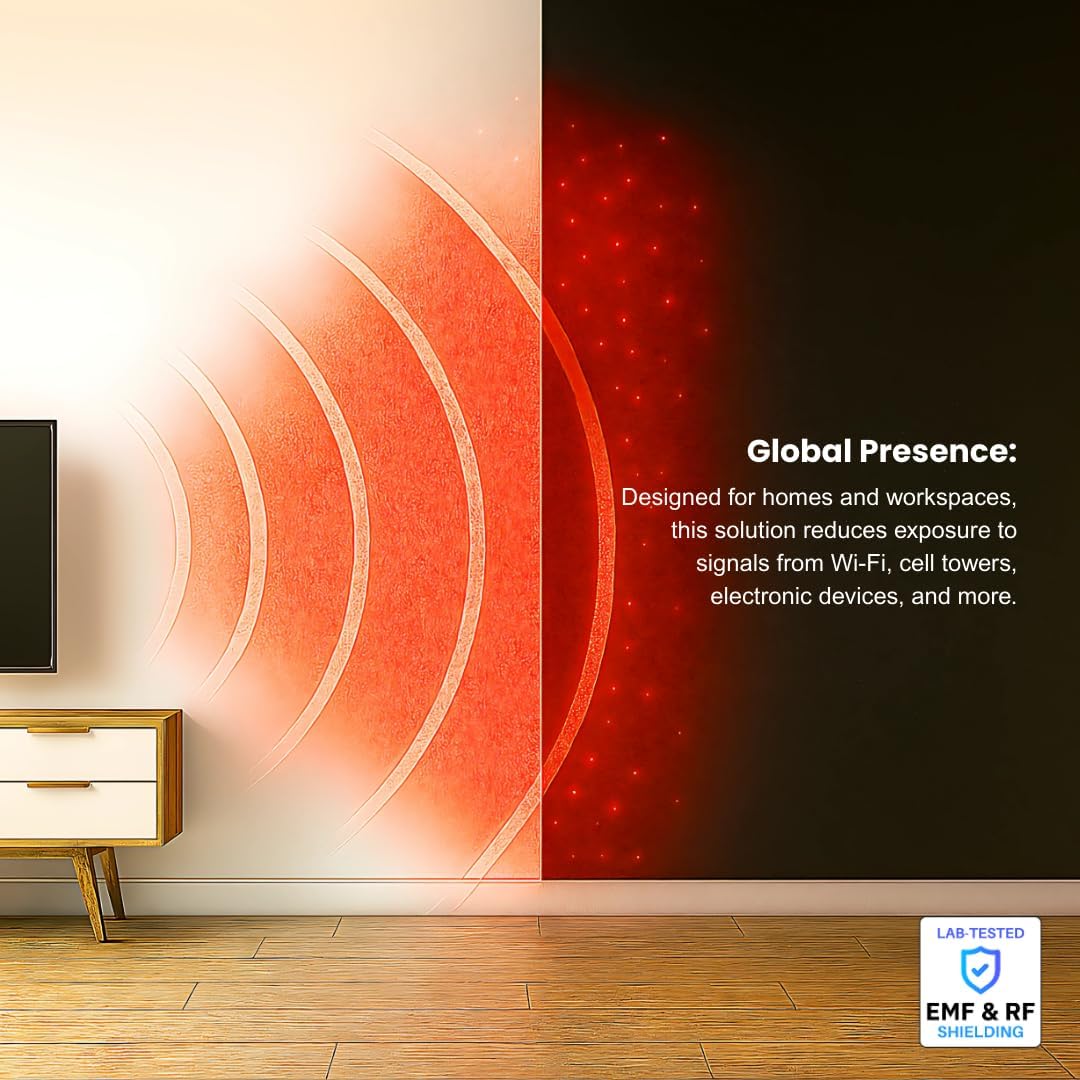
Controlling radio signal propagation in a space relies on a proven physical principle: the Faraday cage. When a conductive envelope surrounds a volume, electromagnetic waves interact with this surface rather than passing freely through it. Part of the energy is reflected, another part is absorbed, and only a very small fraction gets through.
Applied to a modern office building, this principle translates into the coordinated implementation of several technologies:
Conductive wall coatings incorporating carbon, graphite, or metallic components, capable of blocking a major share of RF radiation passing through partitions and ceilings
Transparent technical films applied to glazing, which attenuate waves while preserving natural light
Specific treatments for secondary leakage points: doors, technical ducts, suspended ceilings, outlets, and cable penetrations
Rigorous grounding of all conductive surfaces, without which the entire system loses effectiveness
What the Numbers Say: Real Achievable Performance
This is where RF control moves from concept to measurable engineering. Here are the typical ranges found in proven professional solutions:
Conductive Wall Coatings
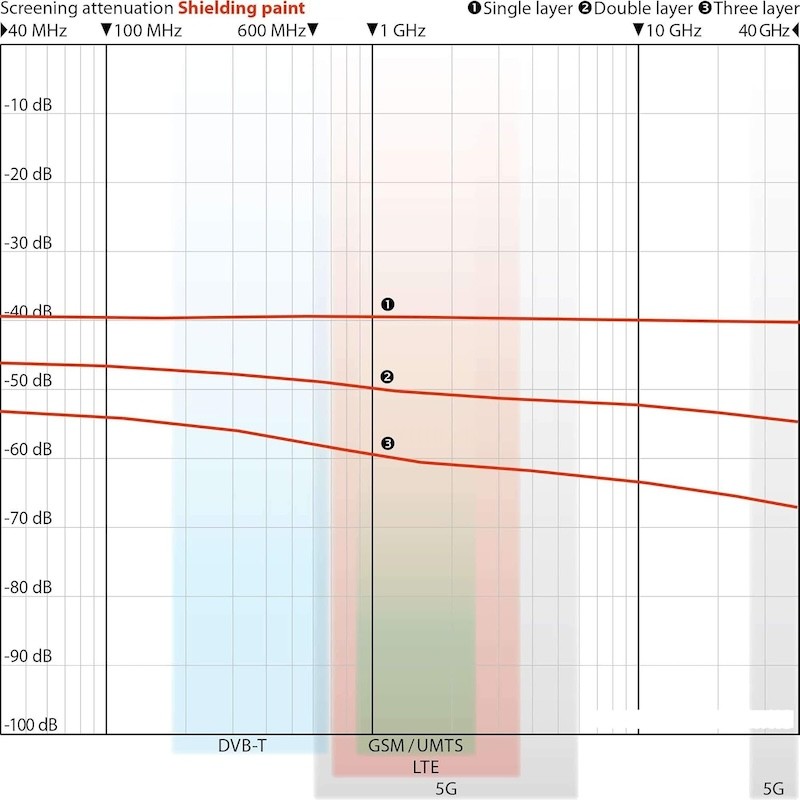
20 to 40 dB attenuation per layer on professional solutions
Possibility to stack layers to reach higher levels when the application requires it
99% to 99.99% reduction of transmitted RF energy depending on the number of layers and implementation quality
Wideband effectiveness covering Wi-Fi 2.4 GHz, 5 GHz, and 6 GHz, Bluetooth, 4G and 5G cellular signals, as well as microwave frequencies used by certain industrial and measurement equipment
Frequency coverage that can reach several tens of gigahertz depending on formulations
Technical Films for Glazing
14 to 35 dB attenuation on common commercial films
Up to 40 dB and above on advanced conductive-structure films used in laboratory environments
Light transmission maintained between 65% and 75% depending on models, preserving the natural light contribution essential to workplace comfort
How to Interpret These Values
Attenuation is measured in decibels on a logarithmic scale. A few concrete reference points:
Attenuation | RF Energy Reduction | Practical Effect |
|---|---|---|
10 dB | 90% | Noticeable attenuation but signal still usable |
20 dB | 99% | Strong attenuation; signal becomes marginal for most uses |
30 dB | 99.9% | Serious confinement; remote use is very difficult |
40 dB | 99.99% | Near-total confinement, controlled RF environment |
50 dB | 99.999% | Laboratory-level or very high-requirement environment |
In practical terms, 20 to 30 dB attenuation is largely sufficient to neutralize most risks related to Wi-Fi leakage outside an office building. Beyond 40 dB, we enter configurations such as test laboratories or high-security environments.
The Crucial Condition: Grounding
Conductive coatings only become truly effective once the layer is connected to the building ground. This grounding allows currents induced by absorbed electromagnetic waves to be drained away. Without it, real-world effectiveness can drop by several tens of percent compared with values announced in laboratories.
This step, which may seem trivial, is one of the main causes of failure in poorly managed projects. It is also one of the key differences between an amateur application and an engineering-grade implementation.
The Weak Link: Windows
This is the most frequently underestimated point. When walls are shielded, windows automatically become the main signal leakage path. Standard glass blocks very little radio energy. A modern building with large glazed areas may leak most of its Wi-Fi radiation through openings, even if internal partitions are perfectly treated.
Approximate RF attenuation by material:
Material | Typical Attenuation |
|---|---|
Standard glass | 1 to 3 dB (negligible) |
Drywall / plasterboard partition | 2 to 4 dB |
Solid brick | 6 to 12 dB |
Reinforced concrete | 10 to 25 dB |
Low-emissivity glass | 20 to 35 dB (variable and unpredictable) |
RF shielding coating properly implemented | 20 to 40 dB per layer |
Shielding film for glazing | 14 to 35 dB |
The case of low-emissivity glass deserves special attention. Very common in Luxembourg buildings certified BREEAM or DGNB for thermal performance, it contains a thin metallic layer that can strongly attenuate RF signals—but in an uncontrolled and uneven way. This can simultaneously create dead zones inside the building and localized leakage through seals, openings, or areas where the coating is less dense.
Diagnosing this behavior requires specific measurements. Without this step, it is impossible to know whether existing glazing is an asset or a handicap for the project, and impossible to properly size the required additions.
Designing a Controlled RF Space: The Engineering Approach
Whether the goal is confidentiality, interference reduction, or protection of sensitive equipment, the method remains the same. A coherent engineering approach combines several elements that must all be designed together from the planning phase:
Initial diagnosis with a spectrum analyzer to measure the existing RF environment and quantify ambient noise, current leakage, and interference sources
Definition of attenuation targets based on the use case: 20 dB is enough to reduce neighboring interference, while 30 to 40 dB is recommended for confidentiality in a sensitive meeting room
Conductive treatment of all four walls, the ceiling, and ideally the floor
Shielding films on all glazing, both internal and external
RF sealing of doors with conductive gaskets to prevent perimeter leakage
Grounding of all conductive surfaces, carefully connected to the building grounding system
Dedicated Wi-Fi access point inside the space, configured at reduced power and on channels not used by external networks
Validation measurements with a spectrum analyzer after treatment, to quantify the attenuation actually achieved and issue an enforceable report
The final step is crucial. Without quantified validation measurements, it is impossible to guarantee to the client that the space meets its objectives. This is what distinguishes an engineering deliverable from a simple finishing-work intervention.
High-Stakes Use Cases in Luxembourg
Confidential Meeting Rooms
Executive committees, M&A negotiations, sensitive client meetings, legal meetings. Typical target: 30 to 40 dB attenuation to make any external listening impractical.
Multi-Tenant Environments
In a building where several companies share the same floors, RF control makes it possible to isolate each tenant and avoid both mutual interference and cross-listening risks. Typical target: 20 to 30 dB attenuation between zones.
Server Rooms and Technical Areas
Confinement of signals emitted by equipment and protection against external electromagnetic disturbances.
R&D Spaces and Laboratories
Control of the RF environment for testing, measurements, and intellectual property protection. Typical target: 40 dB and above depending on business requirements.
Trading Floors
Strict control of wireless communications in spaces where regulatory compliance requires full traceability.
Executive Offices
Targeted protection for the most sensitive individual spaces, without requiring treatment of the entire premises.
Open Spaces Saturated by Neighboring Networks
Reduction of incoming RF pollution to recover internal Wi-Fi performance, particularly useful in dense districts such as Kirchberg.
Each case requires a different technical response. The required attenuation level, target frequencies, compatibility with existing architecture, and aesthetic constraints vary considerably from one project to another. There is no universal solution.
The Other Side of the Problem: When Signals Must Be Let Through
For completeness, it is important to mention the mirror issue faced by many modern buildings in Luxembourg: low-emissivity glazing unintentionally blocks mobile signals, creating cellular dead zones inside buildings. Innovative solutions now exist to restore this mobile connectivity without compromising the thermal performance of the glass.
Blocking RF on one side, letting it pass on the other: these are the two sides of the same expertise in RF engineering applied to buildings. A topic we will cover in a dedicated upcoming article.
The Meltwain Approach
An RF control project is not a finishing-work project. It is a radio engineering project that requires a fine understanding of wave propagation, rigorous measurement before and after intervention, and coherent integration with the existing Wi-Fi architecture.
Choosing the right materials, properly sizing the surfaces to be treated, anticipating leakage points, guaranteeing grounding, validating final performance: each of these steps requires specific expertise. A design error can turn a substantial investment into a false sense of security—the worst possible scenario for an organization that believed it was protecting sensitive information or solving interference issues.
At Meltwain, we support Luxembourg companies with a complete approach:
Initial RF audit using a spectrum analyzer and Ekahau Site Survey to precisely map current signal propagation inside and around your building
Risk and performance analysis identifying leakage areas, interference sources, and potential attack surfaces
Technical design defining target attenuation levels, surfaces to treat, and material choices suited to your environment
Selection and coordination of specialized installers for implementation
Post-intervention validation measurements with quantified reporting, to objectively demonstrate the solution’s effectiveness
Wi-Fi reconfiguration of access points to adapt to the new RF environment
Our expertise is based on CWNE #536 (Certified Wireless Network Expert) certification—one of the most demanding in the global Wi-Fi industry—and on extensive field experience with demanding clients in France, Belgium, and Luxembourg.
In Conclusion
Controlling RF propagation in a building is neither technological paranoia nor a luxury reserved for laboratories. It is about applying to wireless systems the same principles of measurable engineering and defense in depth that have long structured physical security, cybersecurity, and operational quality in organizations.
For Luxembourg organizations, this control addresses four concrete needs: reduce interference from neighboring networks, contain leakage of signals to the outside, protect sensitive equipment from external RF disturbances, and guarantee confidentiality of the most strategic internal communications.
The question is not “is my Wi-Fi leaking?”—it always leaks, to some extent. The real questions are: “Do I know how far it leaks? How many external signals are disrupting my equipment? And are these levels acceptable given my stakes?”
This is exactly what a Meltwain RF audit answers, with quantified and enforceable measurements.
Would you like to assess RF propagation in your Luxembourg premises? Contact Meltwain for a confidential Wi-Fi audit →