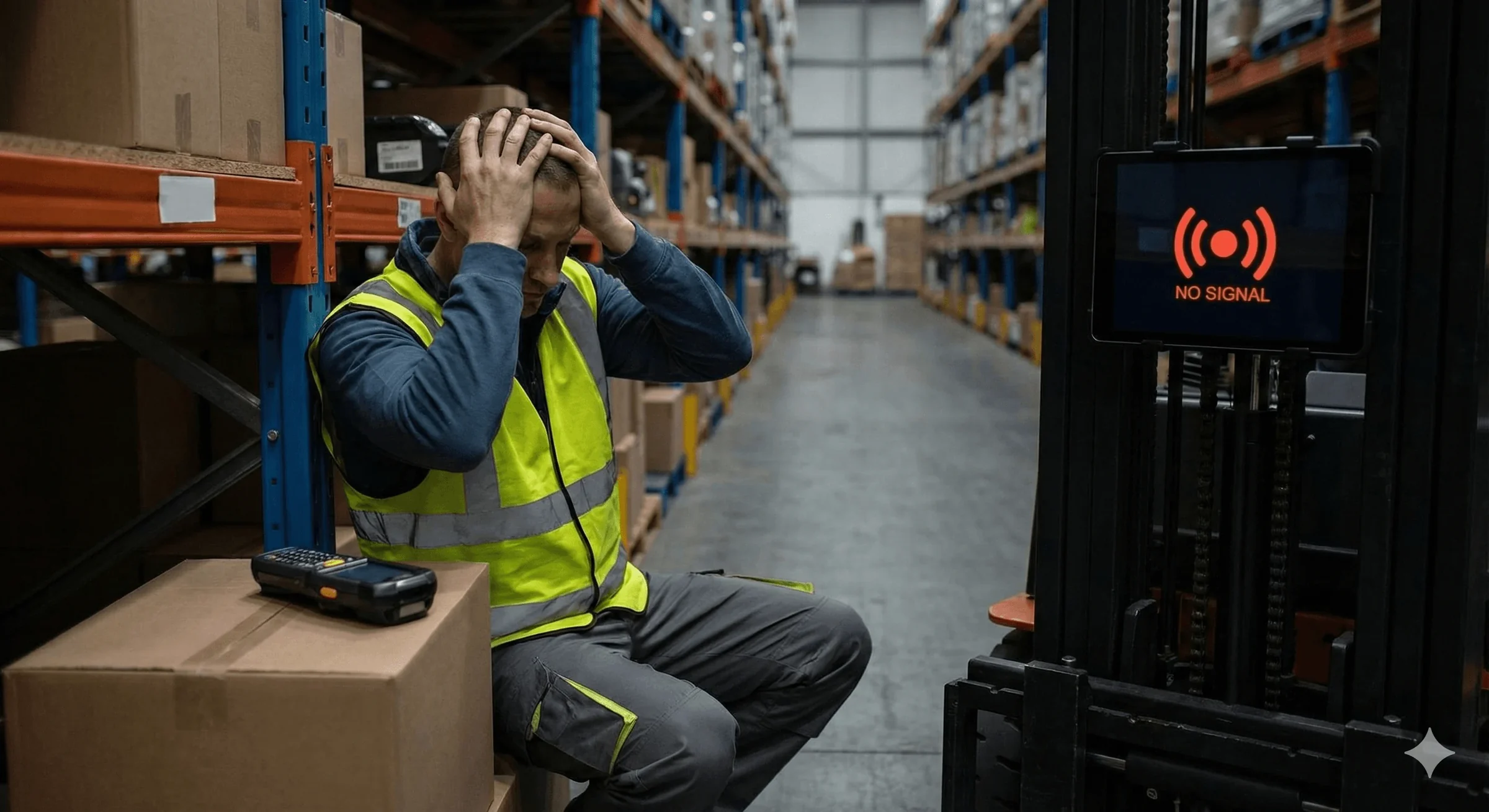
A scanner that loses its signal. An AGV that stops dead in the middle of an aisle. An operator waiting for the connection to come back before confirming a picking order. In a warehouse, a thirty-second Wi-Fi outage can throw a whole chain of operations into disarray and cost far more than you would imagine.
Yet the wireless network remains the poor relation of logistics infrastructure. Money goes into racking, handling equipment and the WMS, and Wi-Fi is deployed last, almost as an afterthought. That is a mistake.
The warehouse, a hostile environment for Wi-Fi
Unlike an office or a retail space, a warehouse combines the conditions that complicate the propagation of radio waves.
Metal racking
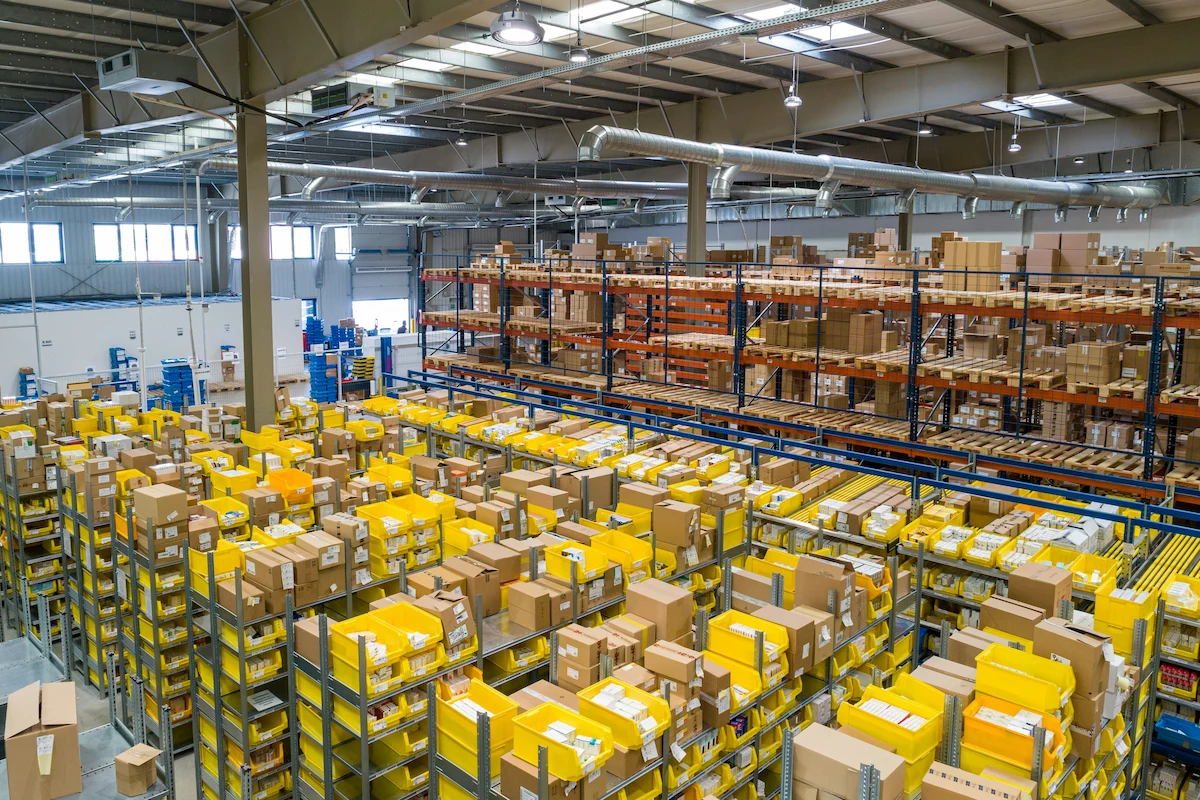
It reflects and absorbs the signal. Depending on its height, density and orientation, it creates unpredictable shadow zones, which only a field survey can locate precisely.
Ceiling height
A warehouse 12 metres high at the ridge is not covered like one of 6 metres. Mounting height of the access points, angle of the antennas, transmit power: everything is calculated from the real geometry of the building.
Sectional doors and loading bays
These are critical transition zones. A vehicle or an operator moving between inside and outside must keep the connection without interruption.
Device density
It can be very high at peak times: scanners, tablets, mobile terminals, AGVs, IoT sensors, surveillance cameras. All of them share the same radio network.
What really depends on a warehouse's Wi-Fi
In a modern warehouse, the wireless network is critical infrastructure. Here is what relies on it in real time:
- scanners and picking terminals: every pick confirmation, every goods receipt goes through the network;
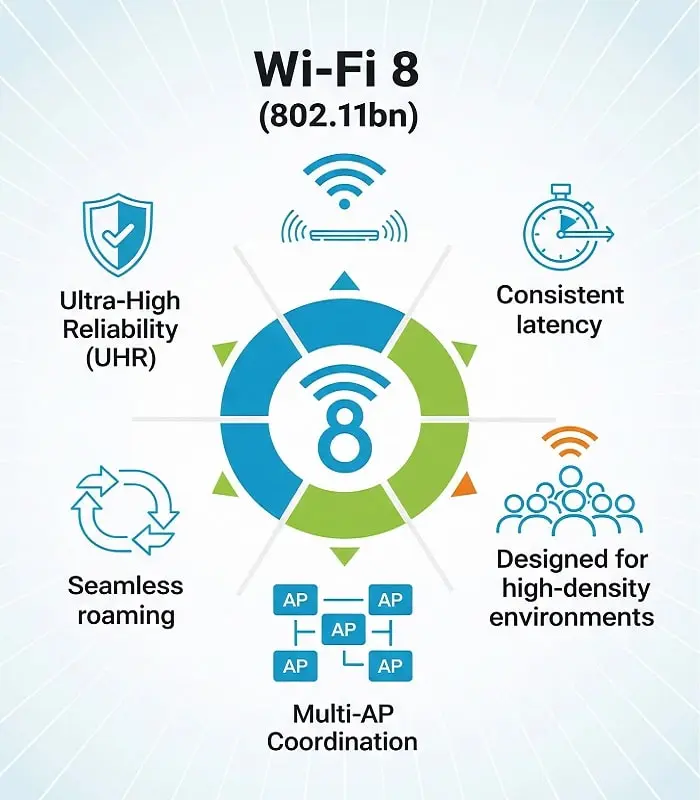
- AGVs and mobile robots: their navigation and their movement instructions depend on a stable, low-latency connection;
- the WMS (Warehouse Management System): stock data, task orders, shipping confirmations, everything travels in real time;
- video surveillance and access control: often overlooked when the network is sized, they consume significant bandwidth.
A single dead zone on the route of an operator or an AGV is enough to create a bottleneck.
What a Wi-Fi survey changes in practice
Before the first access point is installed, a professional Wi-Fi survey does four things.
Mapping the building
Identifying the materials, the heights and the possible sources of interference: motors, industrial frequencies, neighbouring networks.
Simulating coverage from plans
Setting the number of access points needed, their positions and their configuration, before any physical work.
Planning for change
A warehouse that will take on more AGVs or a new storage area tomorrow must be able to adapt its network without starting again.
Validating the deployment on site
After installation, a field measurement confirms that coverage, capacity and roaming (the handover between access points) meet the operational requirements.
The result is a network designed for your warehouse, not a generic network adapted after the fact.
A network equal to your operations
Meltwain works in warehouses of every size and layout, in Luxembourg and elsewhere in Europe. Our surveys take in the constraints specific to industrial environments: high-density racking, AGVs, WMS, IoT. Our founder is certified CWNE #536, one of the most demanding Wi-Fi certifications in the world.
If your site suffers outages, or if you are preparing an extension or the arrival of new AGVs, describe it to us on a call: we will tell you which survey fits.